
Your brain is wired to make you lose money. Not because you are bad at trading. Because you are human. Here is exactly what is happening and how to catch it.
You bought ETH at $3,200. It dropped to $1,900. You held. You told yourself it would recover. You watched it grind lower for four months. You did not sell.
Two weeks earlier you had a position up 30% and closed it the same day, happy to take the profit and move on.
That sequence right there is not a strategy. It is a cognitive bias called loss aversion. And it is the single most expensive pattern in retail crypto trading.
2x — Losses feel twice as painful as equivalent gains feel good
73% — of retail crypto traders lose money consistently, with cognitive bias as the primary driver
3.4% — average annual underperformance from holding losing positions rather than selling them.
Why Your Brain Is Working Against You
The brain does not process gains and losses symmetrically. Losing £100 produces roughly twice the psychological pain as gaining £100 produces pleasure. This is one of the most replicated findings in behavioural science.
The reason is evolutionary. For most of human history, losses were genuinely dangerous. Losing food, shelter or safety could kill you. The brain evolved to treat losses as threats requiring an urgent response. That same wiring is now running inside your trading account, treating a 20% drawdown in SOL the same way your ancestors treated a predator.
The market does not care about your threat response. But your decisions do.
The question is never how do I get back to even. The question is what is this asset worth from today’s price.
What It Looks Like on the BTC Chart
Look at what Bitcoin did between November 2021 and June 2022. The people who held through that entire move were not being patient. Most of them were loss averse. They could not sell because selling would make the loss real.
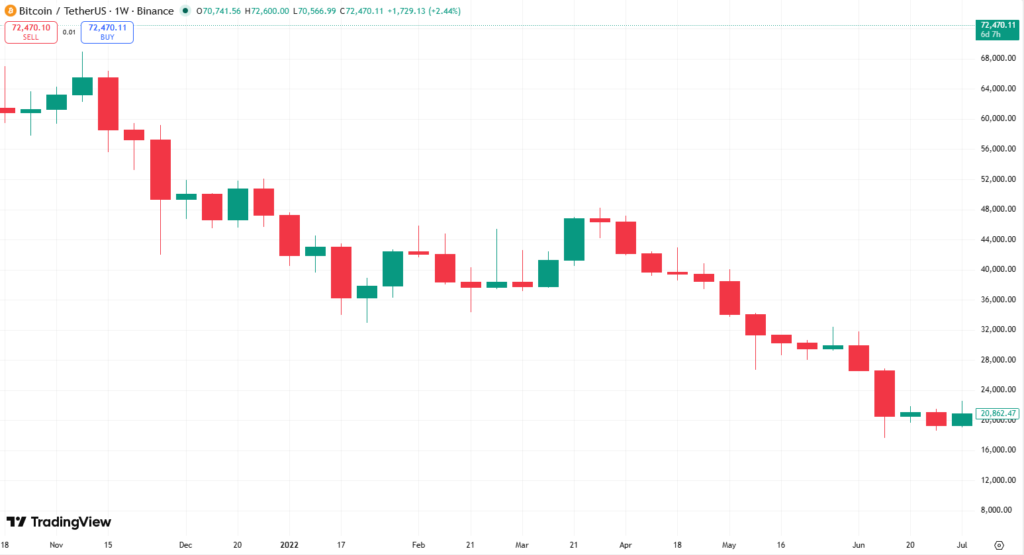
Every week that chart went lower, exiting became psychologically harder. The loss was already so large that selling felt pointless. This is the trap. The size of an unrealised loss makes it feel more permanent to hold than to sell, even when holding makes it larger.
The Two Mistakes That Compound Each Other
Loss aversion does not just stop you selling losers. It makes you sell winners too early. These two behaviours work together to systematically destroy returns even when your asset selection is correct.
Mistake 01 — You hold the losers Selling a losing position makes the loss real and final. As long as the position is open, there is still hope. Your brain treats that hope as a reason to stay in, regardless of what the chart is doing.
Mistake 02 — You sell the winners Profitable positions feel fragile. The market might take the gain back. Closing early feels safe. So you exit at 25% when the trade had 200% left to run.
Researchers named this combination the disposition effect. You dispose of your winners and keep your losers. Every losing position you hold consumes capital and attention that could be in a working trade. Every winning position you close too early cuts a trend that was in your favour.
The ETH Recovery That Fooled Everyone
Here is where it gets worse. Sometimes the market recovers and the loss averse trader feels vindicated. ETH went from $880 in June 2022 back up toward $2,000 by early 2023. Some holders made their money back. And they walked away convinced that holding was the right strategy.
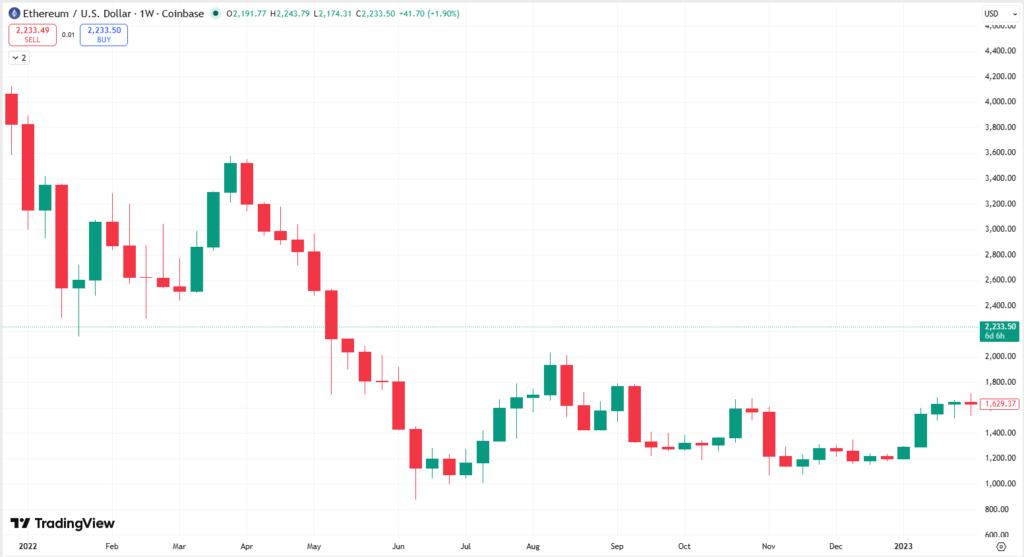
The problem is survivorship. For every ETH that partially recovered, there are tokens from the same era that went to near zero and never came back. Loss aversion does not know which outcome is coming. It just makes you hold regardless.
BTC Dominance and the Rotation Trap
One of the clearest expressions of loss aversion in real time is altcoin holders refusing to rotate into BTC when dominance is rising. They hold an altcoin losing ground to Bitcoin because selling it and buying BTC would mean realising the relative loss.
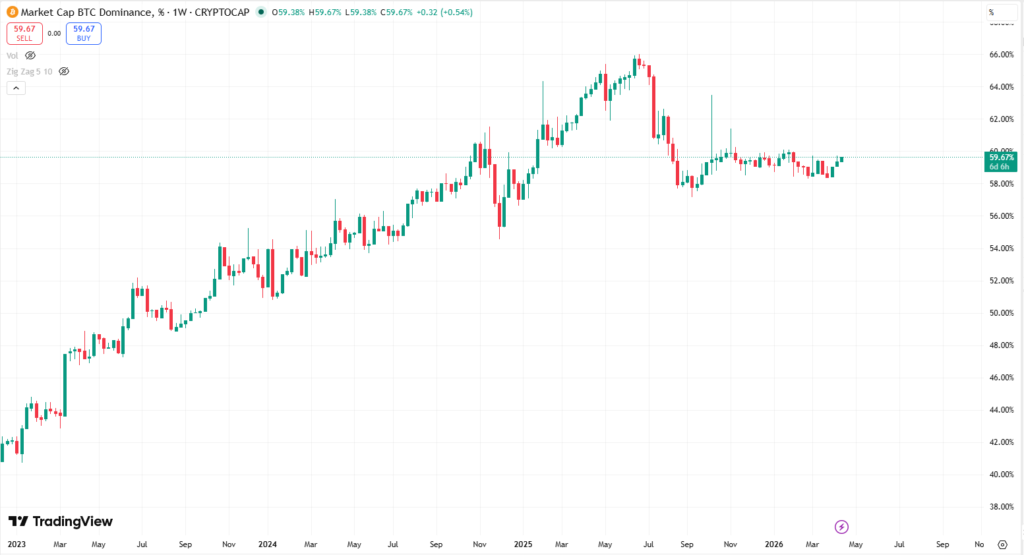
The rational move during a dominance expansion is to reduce altcoin exposure. The loss averse move is to hold the altcoin and watch it bleed in BTC terms, because exiting means accepting you were wrong. Being wrong and taking the loss are the same psychological event. The brain avoids both.
Four Questions That Reveal If This Is You
Most traders experiencing loss aversion believe they are being strategic. Answer these honestly.
01 — Would you buy your current losing positions at today’s price if you had cash sitting idle? If the answer is no, you are holding them for psychological reasons, not trading reasons.
02 — Have you closed any winning positions in the last month while still holding a losing one from the same period?
03 — Do you think about your losing positions more than your profitable ones?
04 — If a friend described your current losing position to you as their own, what would you tell them to do?
The entry price is not information the market has access to. It does not know where you bought. It will not return to that level to help you break even. Your reference point is invisible to every other participant. Trading decisions made relative to your entry price are made relative to something the market cannot see and does not care about.
What Traders Who Manage This Well Actually Do Differently
They do not feel less pain. They have rules set before the trade opens that take the decision out of the emotional moment entirely.
A pre-committed stop loss decided at entry does not require a decision when the price hits it. It executes. The loss averse brain never gets to weigh in because the decision was already made in a calm state, before money was on the line.
Position sizing set before entry means a 40% drawdown on one position is a known, survivable outcome rather than a catastrophe requiring psychological negotiation. When losses are planned for, they stop feeling like failures.
Written trade criteria reviewed against actual behaviour close the gap between what you believe you are doing and what you are actually doing. Most traders who review this honestly are surprised at the pattern they find.